Keplars combines transactional email sending and marketing campaigns in one platform, with tools for creating messages, managing audiences, and tracking delivery and engagement. It is designed to make email setup less demanding for developers and marketers: users can connect a Gmail or Outlook account through OAuth, or send from a verified custom domain, and use API, SMTP, webhooks, or SDKs to connect email to their applications and workflows. The product page says the OAuth setup avoids storing account passwords and configures SPF, DKIM, and DMARC automatically for verified domains.
Key features
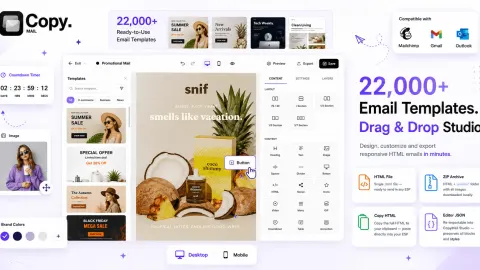
Keplars supports transactional messages such as registration confirmations, password resets, alerts, and product notifications, alongside scheduled marketing campaigns. This shared setup may suit teams that want operational and promotional email tools in one place. Campaigns can be built in a visual drag-and-drop editor or with code, and the page says users can also import Canva and Figma designs as templates. Contacts can be imported or added individually, then organized into audiences for campaigns.
For developers, Keplars offers API and SMTP access, webhooks, and SDKs. The product page lists integrations with tools including Firebase, Vercel, n8n, Zapier, and Bubble, and claims more than 100 native integrations across CRMs, e-commerce tools, and development stacks. The product owner also describes multi-step automations with triggers, delays, and conditions, such as welcome series and post-purchase follow-ups.
Tracking covers delivery, bounces, opens, and clicks, including engagement by recipient. Mailbox warmups are intended to build sender trust gradually. A sandbox is also described for testing templates, flows, and client campaigns before sending them to real inboxes. Teams moving from SendGrid, Postmark, or Resend can import templates, according to the page.
Sending options and deliverability
An important distinction is how sending credentials are configured. When Keplars sends through a connected Gmail, Google Workspace, or Outlook account, messages use that provider’s infrastructure and count against its sending limits. The product owner gives examples of daily caps for Gmail and Google Workspace. With credentials tied to a verified custom domain, sending instead uses Keplars’ transactional infrastructure, with SPF, DKIM, and DMARC authentication on the domain.
Keplars advertises 99.77% inbox delivery, but its response to a customer question says the figure has not been measured through a formal benchmarking tool. It reports delivery above 99% in its experience, while noting that results depend on sender-domain reputation. The page also says dedicated IPs are not available, because the service routes through Gmail, Google Workspace, and Outlook infrastructure for OAuth sends. These details matter when assessing deliverability for a particular sending setup.
Who it is for
Keplars is aimed at product developers, startup teams, indie founders, agencies, email marketers, and no-code or automation builders. Developers can trigger transactional messages from applications and use the tracking tools to investigate delivery problems. Marketers can create and schedule audience campaigns, while agencies can manage sending for multiple clients with isolated sending setups. Bloggers and platform operators are also mentioned as potential users.
Limitations
Security and compliance claims deserve careful consideration. In its response to a customer concern, Keplars says SOC 2 Type I and a formal GDPR audit are still in progress; its stated TLS, encryption-at-rest, backup, and monitoring practices have not yet been independently verified. The product owner advises against using the service for sensitive or regulated data until those audits are complete. Teams with those requirements should factor this into their evaluation.
The sending route also affects limits: OAuth-based sending remains subject to the connected email provider’s caps, while custom-domain sending uses Keplars’ infrastructure. The page does not offer dedicated IPs. These constraints may matter for high-volume senders or organizations that require more control over sending infrastructure.
Verdict
Keplars brings transactional sending, marketing campaigns, automation, integrations, and delivery tracking together, with setup paths for both connected inboxes and custom domains. Its range of developer interfaces and campaign tools makes it relevant to teams that want to handle product email and audience communications in one system. Before relying on it for critical or high-volume sending, users should confirm which sending route fits their needs and account for the stated provider limits, lack of dedicated IPs, and incomplete independent security audits.