Tough Tongue AI
Build AI agents that handle live calls, run demos, and coach reps—then deploy them anywhere
Overview
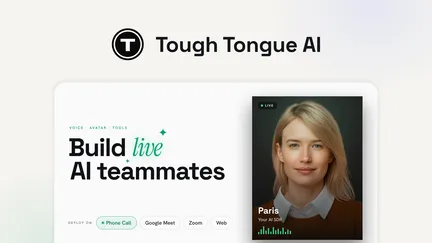
Tough Tongue AI is a purpose-built platform for creating, customizing, and deploying multimodal AI agents that handle live conversations, run demos, and coach human teammates. It targets scenarios that are both repetitive and high-impact: outbound and inbound sales calls, product demos, interview practice, and leadership coaching. The product emphasizes realistic voice roleplay, multimodal interactions (audio, video, slides, whiteboards, code editors), and automated scoring with actionable feedback.
Key features
- Scenario Studio: Build custom agents from plain-English prompts, recordings, slide decks, and documentation. The studio lets non-engineers define conversation flows, memory, tools, and multimodal prompts without low-level configuration.
- Multimodal session capabilities: Agents can speak and listen, present slides, use interactive whiteboards, ask MCQs, and even drive a browser during roleplays or demos.
- Meeting participation and telephony: Agents can join Google Meet and Zoom as participants, dial outbound numbers, pick up inbound calls, and integrate with SIP trunks via providers like Twilio, Plivo, or Vonage (for telephony deployment).
- Embeds and distribution: Deploy an agent via direct link, iframe, or widget so prospects and trainees can access simulations and demos from web pages or embedded flows.
- Live assistance (Truely): An invisible, in-call assistant provides real-time tips, suggested questions, and citations while screen sharing, enabling coaching without interrupting the flow.
- AI scoring and analytics: Every session is transcribed and analyzed against customizable scorecards and rubrics (vocal authority, pacing, clarity, presence, objection handling). The platform produces debriefs with transcript-backed citations, drills, and talk tracks to close skill gaps.
- Persistent memory and personalized coaching: Memory that carries progress across sessions enables longitudinal coaching programs and progressive scenario difficulty.
- Templates and model management: A library of pre-built scenarios for sales, interviews, customer support, and demos plus the ability to use multiple AI models. BYOK (bring-your-own-key) support allows teams to route calls/processing through their own OpenAI/Gemini keys and control cost and model choice.
- Integrations: Native connections for Calendly/Cal.com, Gmail, Google Sheets, HubSpot, Google Meet, and Zoom streamline data flow and scheduling.
- Recording and review features: Full transcripts, recordings, and per-session analytics make it easy to audit and iterate on agent behavior and training outcomes.
Strengths
- Realism and multimodality: The combination of voice, video, slides, and interactive tools makes simulations feel close to live interactions—important for reps who need to practice demos and objection-handling.
- Low-friction authoring: Plain-English agent creation and templates reduce ramp time for non-technical users and speed up the creation of domain-specific agents.
- Deployability: Ability to participate in real meetings and place/receive phone calls makes these agents operational (not just training sims), enabling automation of routine demos and lead qualification.
- Actionable coaching: Scoring tied to transcript citations and suggested drills creates an outcome-driven feedback loop that’s useful for managers who want measurable improvement.
- Security and customization options: BYOK and model selection give teams control over where model inference happens and potential cost/latency trade-offs.
Weaknesses and considerations
- Complexity of production readiness: Building a robust agent that reliably runs a product demo end-to-end will still require careful scripting, slide sync, and testing—especially if the demo must interact with live web apps or variable product states.
- Model behavior and safety: Autonomous agents on calls introduce risks (misstatements, inappropriate responses). Teams will need guardrails, monitoring, and escalation paths to ensure brand and compliance safety.
- Evaluation transparency: While scoring is helpful, teams should validate the rubric outputs against human raters early on to avoid over-reliance on automated judgments.
- Resource needs and limits: Depending on the scale of deployment (concurrent sessions, BYOK usage), operational costs and account limits could become considerations; plan capacity for BYOK minutes and concurrent session counts.
- Language and accent coverage: The review data doesn’t fully detail multilingual support or accent robustness—teams with global audiences should test voice recognition and generation across target dialects.
Setup & integrations
Getting started is straightforward: import assets (recordings, decks), use Scenario Studio to generate an agent, and test in sandbox sessions. For telephony, set up a SIP trunk with a provider and configure E.164 numbers. Integrations with CRM and scheduling tools let agents read/write lead data and book follow-ups automatically. Onboarding support and documentation are available for implementation planning and tuning.
Who it’s for
- Sales teams that want to automate routine demos and scale lead qualification without adding headcount.
- Sales managers and enablement leaders looking for repeatable coaching programs with measurable outcomes.
- Recruiting and hiring teams that need scalable, realistic interview practice.
- Small businesses and growth-stage teams that need to simulate high-stakes conversations (negotiations, investor pitches) without dedicating senior time.
Verdict
Tough Tongue AI is a flexible platform that blends realistic multimodal roleplay with deployable automation and robust coaching analytics. For teams prepared to invest the time to design high-quality scenarios and implement safety controls, it can reduce repetitive workload and accelerate rep skill development. Its strengths lie in realistic interactions, low-code scenario building, and integrated scoring; the main caveats are the need for careful testing in production deployments and verification of automated scoring against human judgment. If your priority is turning routine calls and demos into scalable, inspectable processes while simultaneously improving human performance through data-driven coaching, this platform is worth evaluating in a pilot.