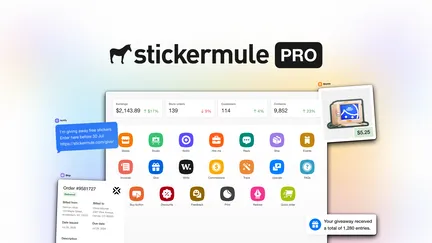
Sticker Mule Pro
Manage your store, email campaigns, shipping, and content from one all-in-one business platform
Sticker Mule Pro — Feature-Focused Software Review
Sticker Mule Pro is an all-in-one business platform that combines storefronts, fulfillment, marketing, content publishing, and order logistics into a single dashboard. It’s built to reduce tool fragmentation for small teams, creators, and solo entrepreneurs who want to run commerce, audience growth, and fulfillment without stitching together many separate apps. Below I break down the core features, strengths, and limitations based on the product information.
Core feature set — what you get
-
Stores: A lightweight e-commerce storefront that lets you set up products and begin selling quickly. The platform handles fulfillment for physical goods, which removes the need to manage production or packing in-house. It also supports selling services via a “Hire Me” model, so creators can list offerings and accept payments without a separate marketplace.
-
Notify (Email + SMS): Built-in campaign tools let you send both email and SMS to your audience. Having email and SMS in the same platform simplifies audience segmentation and campaign management and removes the need for a separate ESP.
-
Give (Giveaways) and Events: Integrated audience growth tools — run giveaways to capture subscribers and host both in-person and virtual events. These are useful for list-building and engagement without bringing in external marketing tools.
-
Write (Blog CMS): A native content publishing system for blog posts and SEO-driven pages. Writing from the same dashboard that manages your store and campaigns reduces friction when driving organic traffic and linking content to product pages or promotions.
-
Studio (Design Tools): On-platform graphic design utilities for quick assets — store listings, social graphics, and campaign creative. Useful for teams without dedicated designers for producing consistent branding assets.
-
Ship (Shipping & Fulfillment Tools): Ability to generate UPS shipping labels and manage outgoing orders in one place, plus a shipments tracking dashboard. Because fulfillment is handled, the Ship tools focus on label creation, order status, and tracking rather than manufacturing.
-
Reply (Shared Inbox): Centralizes customer messages coming from X (formerly Twitter) and email into a single shared inbox, which helps teams maintain context and reduces lost support threads.
-
Image utilities: Trace (background removal), Upscale (image enlargement), and Redraw (convert images to vector). These are helpful for product imagery and print-ready assets when selling custom-branded materials.
-
Commissions and Referral Program: Tools to earn referral commissions by sharing products with your audience, turning followers into a passive revenue stream.
UX and dashboards
The interface emphasizes unified workflows: store dashboards, SMS campaign analytics, shipments tracking, and blog/editor screens are presented as connected modules. The SMS and campaign analytics visualization appears geared toward quick performance checks, while shipment and support inbox tools centralize operational visibility. The design suggests a focus on streamlined onboarding and rapid setup — “set up a storefront in minutes” is a recurring theme.
Strengths
-
Real integration between commerce, marketing, and fulfillment: The biggest advantage is the reduced number of handoffs. You can create a product, design imagery, publish SEO content, run a campaign, and ship orders without leaving the platform.
-
Turnkey fulfillment: Handling production/fulfillment is ideal for small sellers and creators who don’t want to pack or manage manufacturing partners.
-
Built-in growth tools: Giveaway, events, and referral features help accelerate audience building without extra tools.
-
Helpful image tools: Trace, Upscale, and Redraw are practical for creators selling print goods; having them in-platform saves time and prevents file export/import complexities.
-
Unified customer communications: A shared inbox that aggregates messages from social and email reduces context switching for support teams.
Limitations and considerations
-
Regional availability: The product is not yet available everywhere. Businesses should confirm availability and shipping coverage in their region before committing to the workflow.
-
Depth vs. breadth: The platform prioritizes an integrated experience over deeply specialized features. Larger merchants or teams with advanced commerce needs (complex tax rules, multi-currency, custom integrations, large inventory management) may find the feature depth insufficient compared with dedicated enterprise e-commerce platforms.
-
Integration ecosystem: There’s limited mention of broad third-party integrations or headless/API-first capabilities. If you rely on many existing systems, check integration options.
-
Dependency on platform fulfillment: While handling fulfillment is convenient, it also introduces vendor dependency. Sellers with specialized production needs or custom packaging may find constraints.
Best use cases
-
Solopreneurs and creators who want one place to sell merch, publish content, and run simple marketing campaigns without hiring developers.
-
Small businesses that want outsourced fulfillment and integrated marketing to reduce operations overhead.
-
Marketers running promotional campaigns tied directly to products and needing simple SMS/email execution plus content to support conversions.
Final verdict
Sticker Mule Pro stands out as a pragmatic, tightly integrated platform for businesses that value simplicity and consolidation. It removes many operational frictions by combining storefronts, fulfillment, marketing, and content in one place, and the addition of image utilities and a shared inbox makes it especially attractive to creators and small teams focused on branded merchandise. If you prioritize speed-to-market, lower operational complexity, and an all-inclusive workflow, this platform is a compelling option. If your business requires advanced commerce features, deep integrations, or global availability, evaluate whether the platform’s breadth (integration-first approach) meets your long-term needs.