Rainfrog AI
Use node-based AI workflows to generate consistent campaign visuals from your brand assets
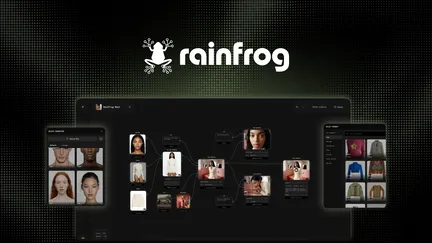
Rainfrog AI — hands-on review of a node-based, prompt-free creative platform
Overview
Rainfrog AI is a web-based creative tool built around a visual node canvas that lets teams generate on-brand images and videos without writing text prompts. It’s designed for art directors, brand teams, marketing agencies, and ecommerce creators who need consistent campaign assets at scale. The platform emphasizes visual control: upload products, characters, styles, and environments to a reusable asset library, then connect nodes to compose and iterate on campaign visuals.
What it does
Rather than relying on typed prompts, Rainfrog assembles generation instructions automatically from a graph of connected asset and generator nodes. You drag-and-drop assets into a canvas, connect them to style/environment nodes, select generator nodes for image or video output, and the system handles prompt construction, model selection, and execution. Outputs and variants are deposited into the project library so teams can remix or clone workflows for new shoots without starting from scratch.
Key features
Node-based visual canvas
- Visual graph editor where assets (products, characters, environments, styles) are nodes.
- Connections between nodes represent composition and art direction, and the platform translates those links into generation inputs.
- Drag-and-drop approach aimed at designers and directors rather than engineers.
Reusable asset libraries
- Upload product shots, model faces/poses, environmental references, and style packs.
- Automatic analysis and tagging of uploaded assets so context and metadata follow assets into new workflows.
- Swap assets in existing graphs to generate consistent variants quickly.
Preset workflows and templates
- Ready-made templates like Fashion Shoot, Product Still Life, and UGC Content to kick off projects.
- Clone and remix presets to explore alternate layouts, lighting, and styling without rebuilding direction.
Consistency-focused generation
- Emphasis on keeping characters, models, and product appearances consistent across many variations—solving a major pain point for campaign work.
- Ability to keep pose/face consistency while swapping outfits, backgrounds, or props.
Multi-model backend and quality options
- Integrates multiple image models (examples include Seedream, GPT Image and others) and chooses the best model per task.
- Options for different quality levels (normal vs. pro) per generator node to balance speed and fidelity.
- Video generation is available within the canvas as a generation node.
Outputs, organization, and remixing
- All generated assets save to a project library for review and reuse.
- Cloneable workflows let teams scale consistent aesthetics across projects (ads, organic posts, product pages).
- Asset context (tags, relationships, references) persists when reused, reducing setup time.
Integrations and extensibility
- Integrates with major AI providers for image generation and supports model selection under the hood.
- Roadmap indicates API/MCP access coming, which would enable programmatic workflows and tighter pipeline integrations.
Workflow and UX
The platform targets creative professionals, not prompt engineers. The node interface is intuitive for designers used to compositing or node-based tools (e.g., Nuke, Blender shader graphs). Creating a campaign typically involves:
- Uploading assets and letting the system tag and analyze them.
- Assembling a node graph that pairs characters/products with styles and environments.
- Toggling generator nodes to produce image or video outputs.
- Iterating by cloning the workflow and swapping assets.
This flow minimizes manual prompt translation and lets art direction live in a visual structure. For teams that collaborate visually, this reduces miscommunication and shortens iteration time.
Output quality
Rainfrog emphasizes “taste-engineered” outputs—trained or tuned to default toward considered, brand-oriented aesthetics. Combining multiple generation models and offering per-node quality controls helps tailor outputs for commercial use. The platform claims strong performance on character and product consistency, an area where many single-prompt tools struggle.
Who it’s best for
- Fashion brands and agencies that need campaign-grade visuals without traditional photoshoots.
- Ecommerce teams needing consistent product imagery across many variants.
- Creatives who prefer visual tooling over prompt engineering.
- Small studios and solo creators who want to scale visual direction while preserving a brand look.
Strengths
- Visual, node-based control maps directly to art direction workflows.
- Reusable libraries and cloning/remixing accelerate repeatable campaigns.
- Strong focus on consistency for characters and products.
- Built-in model selection and quality toggles simplify technical choices.
- Preset templates reduce ramp-up time for common project types.
Limitations and considerations
- The node paradigm has a learning curve if you’re unfamiliar with graph-based editors, though it’s intuitive for many designers.
- Reliance on model choices and automatic prompt assembly means some edge-case, hyper-specific creative directions may still need manual tweaking.
- Roadmap items (API access, expanded packs) indicate the platform is actively evolving; early adopters may encounter feature gaps that will be filled over time.
Verdict
Rainfrog AI is a compelling tool for teams focused on art-directed, brand-consistent visual output. Its node-based approach moves creative control away from textual prompt engineering and into an intuitive, visual space that better mirrors how designers and directors think. If your work relies on consistency across models, characters, or product variants, Rainfrog offers useful workflows and library management to scale that process. The platform is especially attractive for fashion, ecommerce, and agencies that need campaign-ready assets quickly and repeatedly.