Postbeam.ai
Draft LinkedIn content with AI, schedule posts, and turn every engagement into a ranked warm lead
Overview
Postbeam.ai is a LinkedIn-focused content and pipeline platform built to move beyond vanity metrics and turn post engagement into actionable sales opportunities. It combines AI-powered content generation, post scheduling and team workflows with a system that captures and ranks everyone who interacts with your posts — likes, comments, and profile views — then surfaces warm prospects ready for outreach. The product is targeted at B2B teams, agencies, and sales-led companies that want to convert social attention into measurable pipeline without manual digging through notifications.
Core features
-
AI-driven content assistant (Marv): An AI trained on a user's LinkedIn history and preferred tone to draft, brainstorm, and refine posts that match each team member’s voice. Useful for consistency and productivity when producing frequent LinkedIn content.
-
Engagement-to-leads capture: Automatically captures likes, comments, and profile views on posts and applies an Ideal Customer Profile (ICP) filter to identify people most likely to convert. This removes the need for manual triage and turns reactive social data into a proactive lead list.
-
Lead ranking and intent: Prospects are ranked by inferred intent to prioritize outreach. The platform surfaces the warmest contacts first so sellers know exactly who to contact and when.
-
Pre-drafted, contextual outreach: For each ranked prospect Postbeam suggests personalized follow-up messages that reference the exact post or reaction that generated the engagement, speeding up outreach while preserving relevance.
-
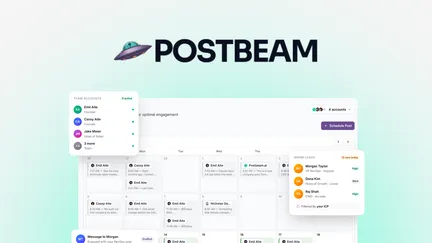
Scheduling and content calendar: A visual calendar (month/week/list views) supports scheduling across multiple LinkedIn accounts, with approval workflows for teams, an image/media library, branded templates, and variables for on-brand, repeatable posts.
-
Team collaboration and shared analytics: Shared dashboard, team-wide analytics, unlimited accounts support, and approval workflows help distributed teams maintain consistency. Analytics include impressions, reactions, reach, and post-level performance so you can iterate on what hooks or formats work best.
-
CRM and comms integration: Exports and syncs to HubSpot, Salesforce, or CSV. Real-time alerts and follow-ups can be routed into Slack and into CRMs to keep pipeline activities visible and actionable.
-
AI integrations (MCP): Connects to external generative AI tools (e.g., ChatGPT and Claude) through an MCP to pull posts, engagement data, and leads into users’ preferred AI workflows for further automation or refinement.
-
Enrichment and contact tools: Includes contact enrichment, connection request automation features, DM sequence templates, and access to a large B2B contact database to help fill missing data when pursuing leads.
-
Compliance and safety: Designed to work through official LinkedIn APIs without browser automation or bots, lowering the risk of policy violations.
Workflow and usability
The typical workflow is straightforward: use Marv to draft a post or import your content, schedule it through the visual calendar, publish through the platform, and then let the lead capture engine watch engagement. When someone engages, Postbeam applies your ICP rules, ranks the contact, and surfaces pre-written outreach messages linked to the original post. Alerts can be pushed to Slack or the CRM, and the team can assign or follow up directly from the shared dashboard. The approval workflow and shared asset library make it easy for agencies or companies with multiple contributors to keep brand voice consistent.
Integrations and technical considerations
Postbeam connects with major CRMs and communication tools, which helps maintain a single source of truth. The MCP integration for external AI tools is a strong plus for teams that already use generative AI and want to keep their writing pipeline consolidated. Because the system relies on LinkedIn APIs for engagement data, there are inherent constraints tied to what LinkedIn exposes (for example, certain profile view data or privacy-limited signals may be partial). The product emphasizes API-based, policy-compliant methods rather than risky browser automation.
Strengths
- Laser-focused on LinkedIn: The specificity makes the platform more useful for B2B social selling than generic schedulers.
- Strong productivity gains: AI drafting, prebuilt outreach, and scheduling tools reduce time to publish and follow up.
- Converts engagement into pipeline: The lead capture + ICP filtering + ranking chain is the core differentiator and directly addresses the problem of engagement without conversion.
- Team-friendly: Approval workflows, shared libraries, and cross-account scheduling support agency and multi-seat deployments.
- Integrations: CRM exports, Slack alerts, and AI connector support make it fit into existing GTM stacks.
Limitations and considerations
- Dependence on LinkedIn data limits: The accuracy and completeness of lead capture are bound by what LinkedIn shares via its APIs.
- Personalization still needs human review: Pre-drafted outreach is a powerful shortcut, but best results require human editing to avoid sounding templated for higher-value prospects.
- ICP configuration: Success depends on well-defined ICPs; teams will need to tune filters to avoid false positives or noisy lead lists.
- Newer product risks: As a focused, evolving product, some advanced features (employee advocacy, broader social networks) may be in early stages or planned rather than fully mature.
Verdict
For B2B marketing and sales teams who prioritize LinkedIn as a primary channel, Postbeam.ai offers a compelling, purpose-built toolset. Its blend of AI writing, visual scheduling, team workflows, and — critically — an engagement-to-leads pipeline is designed to close the loop between content and revenue. It’s especially valuable for teams that produce regular LinkedIn content and want to systematically capture and act on every meaningful engagement. Teams should plan to invest some time in ICP tuning and message customization to get the highest ROI, but the platform’s focus on converting social engagement into prioritized, CRM-ready leads makes it a strong addition to a sales-driven social strategy.