Nuwtonic SEO
Monitor rankings, optimize pages, and generate GEO-ready content for AI search
Summary
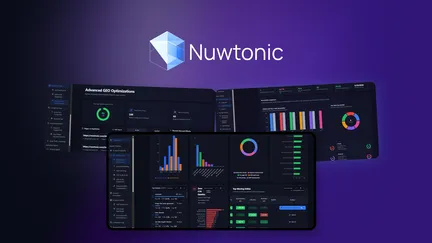
Nuwtonic SEO is an agentic AI-driven SEO and GEO optimization platform built to move beyond diagnostics and into execution. It connects directly to Google Search Console, monitors AI-answer platforms (ChatGPT, Gemini, Perplexity, Claude, etc.), and provides a single workspace to discover why competitors outrank or get cited instead of you, prioritize fixes, and generate GEO-ready, E‑E‑A‑T-rich content. The product aims at marketers, agencies, and SaaS teams who need continuous, scalable SEO work without relying on a deep bench of specialists.
What it does well
- Integrated data ingestion: Nuwtonic pulls live Google Search Console data and combines it with SERP and competitor analysis to surface real, actionable gaps—so recommendations are grounded in your own traffic and queries rather than just generic rules.
- Agentic workflows and one-click fixes: The platform prioritizes opportunities and, crucially, gives recommended fixes and implementation workflows that reduce the manual handoff between audit and execution. That bridge from insight to action is a core differentiator.
- AI model tracking and citation monitoring: It tracks AI visibility and citations across multiple answer sources and models (ChatGPT, Gemini, Perplexity, Claude, Llama, Grok, Google AI, etc.). You can see share-of-voice, prompt coverage, and which competitors are being cited for specific prompts or topics.
- Page and answer readiness scoring: Pages are scored for AI answer readiness, E‑E‑A‑T signals, schema, and “AI Overview” visibility, which helps prioritize the pages most likely to win or lose in AI-driven answer contexts.
- GEO & localized content capabilities: The platform has GEO dashboards, geo-specific gap analysis, and can generate localized content variants—useful for multi-region businesses or local agencies.
- Topical maps and keyword clustering: Nuwtonic auto-creates topical authority maps by combining your site authority, competitor signals, and SERP intent. Keywords are deduplicated semantically and clustered into logical content buckets ready for bulk production.
- Content generation tuned for AI answers: Instead of generic drafts, generated content includes BLUF summaries, tables, schema, and scannable sections designed to increase chances of being referenced by AI answer engines.
- Bulk generation and editorial tooling: Supports bulk article creation, content editing with entity enrichment and internal link recommendations, and workflow exports to CMSs via webhooks or other integrations.
- Reporting and white-label outputs: Offers white-label performance reports and custom dashboards geared to agencies and resellers.
- Lightweight integrations: Besides Google Search Console, webhooks are supported for publishing and automation. The product emphasizes connected agents that share context across the stack.
UX, onboarding and support
The interface is aimed at marketers and non-technical SEOs as much as technical teams. The platform explains why you’re losing visibility (not just what’s broken) and offers prioritized, actionable tasks. There’s a clear playbook mentality—identify → prioritize → execute. Support and founder engagement appear accessible; the team background includes experience at global tech firms and real-world SEO experimentation, which is reflected in a product focus on experimentation and measurable outcomes.
Strengths
- Execution-first philosophy: Fewer “report-only” outputs, more guided fixes and automation.
- AI-aware SEO: Early support for AI citations and model-level tracking gives teams a head start in optimizing for AI answer engines.
- Topical authority tooling: Automated clustering, content maps, and bulk generation make it practical to expand coverage at scale.
- Local/GEO focus: Native features for regional visibility and localized content generation help local businesses and multi-market campaigns.
Limitations and caveats
- Learning curve for sophisticated features: While designed for marketers, fully leveraging topical maps, agentic workflows, and AI-citation tracking benefits from time spent learning the platform.
- Model and feature gating: Access to some future AI models or higher-volume features may depend on plan tiers or add-ons; large-scale deployments will need to validate that quotas and model access meet expectations.
- Integration scope: Current integrations are focused (GSC, webhooks). If your stack relies on deep analytics or rank providers beyond those supported, expect to export/bridge data externally.
- Reliance on third-party AI engines: Performance for AI-citation insights and content generation depends in part on models and APIs external to the platform; monitoring for continuity and model changes is necessary.
Best use cases
- Agencies managing multi-site or multi-market SEO and local clients needing white-labeled reporting and bulk content generation.
- Marketing teams that want to prioritize SEO investments based on real GSC signals and competitive AI-citation gaps.
- Product and content teams seeking to scale topical authority and publish AI-answer-optimized content with fewer manual steps.
Verdict
Nuwtonic is a strong option if your goal is to close the gap between SEO analysis and sustained execution, especially when AI-generated answers are becoming a key channel for discovery. Its agentic approach—agents that analyze, prioritize, and help execute—plus AI-citation monitoring and GEO-ready content generation make it especially valuable for teams that must scale content and technical fixes across many pages and locales. Expect some onboarding investment to unlock the most advanced workflows, and confirm model/access limits for large programs, but overall it’s a practical, forward-looking platform for SEO teams adapting to AI-driven search.