Keplars
Transactional and Marketing Emails Platform
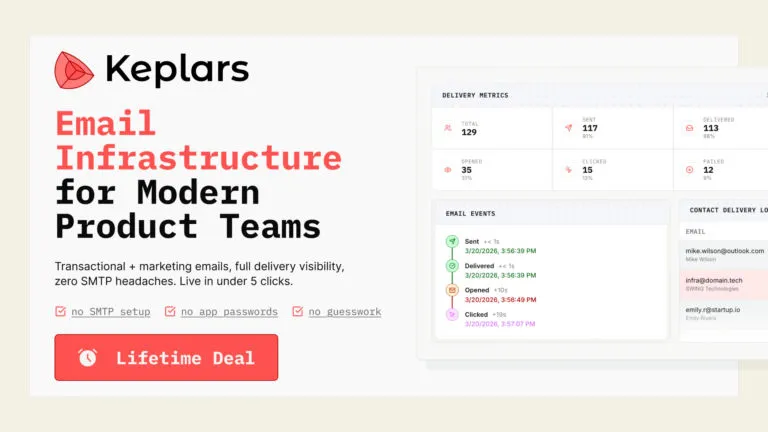
This review evaluates a modern productivity and collaboration platform based on its core functional features. It focuses on how the product supports common workflows, integration needs, team coordination, and technical robustness, with attention to strengths and opportunities for improvement. The review assumes typical use cases such as project management, content collaboration, and process automation.
Features overview
The platform presents a comprehensive suite of features designed to support end-to-end team workflows. Its core capabilities cover task and project management, real-time collaboration, automation of repetitive processes, data visualization and reporting, a robust API surface, and a range of integrations with third-party services. The feature set is clearly aimed at teams that need both flexible, low-friction tools for day-to-day communication and more formal controls for governance and reporting.
User interface and navigation
The UI is clean and modular, with a left-hand navigation rail for quick access to workspaces, projects, and frequently used tools. Key elements:
- A unified command bar that supports fast searching for tasks, files, or people.
- Consistent visual language across modules (icons, color-coding for priorities, and status badges), which reduces cognitive load when switching contexts.
- Customizable views (list, board, timeline, calendar) that let teams adopt Kanban, Gantt, or calendar-driven workflows without leaving the application.
- Inline preview for attachments and rich-text editing in comments and descriptions, enabling more expressive collaboration without external tools.
Opportunities: keyboard shortcut coverage is good but could be expanded; onboarding walkthroughs are present but could surface advanced features more proactively.
Project and task management
The task model supports subtasks, dependencies, recurring tasks, and custom fields. Boards and timelines sync in real time, ensuring changes in one view reflect across all others. Notable features:
- Advanced dependency handling with critical-path highlights for complex projects.
- Bulk edit and templating for repeatable project structures.
- Intelligent task suggestions that use recent activity to surface likely assignees or due dates.
- Built-in time tracking per task with simple start/stop controls and aggregations for project-level estimates versus actuals.
Opportunities: recurring-task rules are flexible but can be confusing for compound recurrence patterns; richer automation around task lifecycle transitions would be useful.
Collaboration and communication
Collaboration is a primary focus. The platform provides threaded comments, @mentions, and in-line discussion threads tied to specific parts of documents or tasks. Additional capabilities:
- Real-time co-editing in documents and the ability to link document sections to tasks.
- Presence indicators and read receipts to reduce duplicated effort.
- Shared team spaces with configurable inboxes and activity feeds for filtering noise.
Opportunities: in-app chat could benefit from richer message formatting and better persistence for long-running conversational threads tied to projects.
Automation and workflows
Automation is robust and accessible through a rules builder and pre-built templates. Users can create triggers based on events (status changes, field updates, dates) and chain actions (notifications, task creation, field updates, webhooks). Highlights:
- A visual workflow editor that balances power and usability.
- Conditional branching and scheduling options for time-based automations.
- Audit logs for automation runs helping with troubleshooting.
Opportunities: more granular retry policies and versioning for workflows would help in enterprise scenarios.
Integrations and APIs
Integration coverage is extensive: common productivity tools, source control, CI/CD systems, cloud storage, and single sign-on providers are supported. The public REST API and webhooks allow building custom connectors. Features include:
- OAuth-based connectors with secure token renewal.
- Two-way synchronization for issues and tickets with popular tracking systems.
- Native import/export utilities for migrating data.
Opportunities: a marketplace for community-built integrations would accelerate adoption in niche ecosystems.
Reporting, analytics, and dashboards
The analytics suite offers customizable dashboards, cross-project reporting, and exportable charts. Capabilities:
- Drag-and-drop dashboard builder with widgets for burndown, velocity, and SLA compliance.
- Ad-hoc reporting with filterable queries and saved reports.
- Scheduled report delivery via email or integrations.
Opportunities: predictive analytics and anomaly detection could add value for capacity planning.
Performance, scalability, and offline support
Performance is solid for small and medium teams; large datasets occasionally show lag in complex queries. The platform scales horizontally and supports pagination and lazy-loading to mitigate UI slowdowns. Offline support exists for mobile apps and limited desktop capabilities, providing read access and queued updates when connectivity resumes.
Opportunities: improving client-side caching and push updates for massive workspaces will reduce perceived latency.
Security, permissions, and compliance
Security features are strong: role-based access control, granular permissions on projects and documents, SSO, and audit trails. Data encryption in transit and at rest is standard. The permissions model supports guest users and external collaborators with restricted scopes.
Opportunities: finer-grained attribute-based access controls and more transparent data residency options would help highly regulated customers.
Customization and extensibility
Administrators can customize fields, views, workflows, and branding. Developer extensibility includes a public API, SDKs for common languages, and the ability to register app extensions that surface within the UI.
Opportunities: more low-code widgets and an events marketplace would make extension easier for non-developers.
Conclusion and recommendations
Overall, the platform offers a well-rounded feature set that addresses the needs of collaborative teams, combining strong task management, flexible automation, and deep integration capabilities. Its strengths are in the quality of the UI, the coherence between different views, and the practical automation features that reduce manual work. Areas to improve include advanced onboarding, richer in-app communication tools, predictive analytics, and performance at very large scale.
Recommended next steps for prospective users: evaluate the platform with a pilot project that exercises integrations, automation workflows, and reporting needs to confirm fit with existing processes and scale expectations.