Fuzen
Customize 45+ ready-made CRM and ERP apps with AI—then deploy them under your own brand
Overview
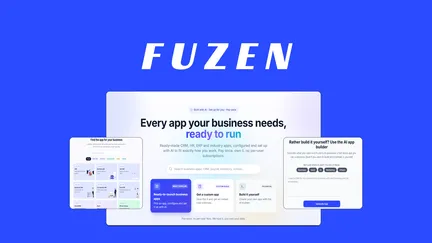
Fuzen is a no-code/low-code platform aimed at quickly delivering full-stack business applications by leaning heavily on AI-driven generation and conversational refinement. It ships with a large library of ready-made CRM, ERP, HR, and industry-specific templates, and it emphasizes customization through natural-language chat rather than manual wiring of forms, logic, or database schemas. The platform also supports white-label deployment, custom domains with automatic SSL, role-based permissions, server-side automations, and a number of integrations for common business tooling.
Who this is for
- Small businesses and solopreneurs who need functional business apps fast without hiring developers.
- Operations teams that want a tailored workflow app (sales pipeline, inventory, field service, school management, legal practice, etc.) but lack engineering resources.
- Agencies and consultants who need to deliver branded apps to clients and want to deploy under custom domains.
- Teams that want to combine multiple AI models (OpenAI, Anthropic, Gemini) and route requests through their own API keys for control and cost management.
Key features
Ready-made app library
Fuzen provides dozens of prebuilt app templates across CRM, ERP, HR, and industry verticals. These templates are intended to be production-ready starting points that can be customized instead of built from scratch.
AI-first app generation and refinement
You can describe a process (e.g., “capture leads, approve quotes, manage inventory, onboard clients”) in plain language and Fuzen’s AI generates a relational app with tables, fields, stages, workflows, and permissions. Further changes are handled via chat: rename fields, add automations, change approval logic — the platform updates the app in real time.
Guided configuration and onboarding
New apps come with a guided setup that walks through data structure, fields, stages, and user roles so you can get an operational app quickly without guessing at the underlying model.
White-labeling and domain control
Apps can be branded fully (logo/branding hidden from end users) and served on a custom domain with automatic SSL handled by the platform. This makes Fuzen suitable for resellers and agencies delivering client-facing applications.
Role-based access and multi-user collaboration
Built-in role and permission controls let admins define who sees and edits which records and modules. The platform supports multiple users collaborating on data simultaneously.
Server-side automations and scheduled jobs
Fuzen generates server-side logic (automations, scheduled jobs, approval rules) so background processes can run without client-side scripting. This helps with recurring tasks, notifications, and multi-step workflows.
Integrations and extensibility
Out-of-the-box integrations include Google Drive, Shopify, Slack, WhatsApp, and Zapier, with API integration capabilities for broader connectivity. There’s support for adding custom code and creating private apps where needed.
AI model flexibility and data control
A notable feature is the ability to connect your own AI provider API keys (OpenAI, Claude, Gemini). This routes model usage through your account, giving you control over model choice, billing, and potentially data residency. Models are configurable at the account level so you can choose the best balance of performance and cost for each feature.
Strengths
- Extremely fast time-to-value when you need a tailored business app but don’t have engineering resources.
- Conversational customization removes a lot of the friction common to drag-and-drop builders.
- Full white-label and custom domain support make it suitable for client-facing deployments.
- Relational data modeling, role-based permissions, and server-side automations mean generated apps are more than just forms — they’re production-capable systems.
- Ability to use your own AI keys is good for security-conscious teams and helps control model costs.
Limitations and caveats
- Because much of the app creation is driven by AI, complex edge-case logic may still require manual review or custom code.
- The platform operates on hosted infrastructure; organizations with strict on-prem or specific data residency requirements should validate compliance and export options.
- Usage is governed by quotas/credits and request limits; teams should evaluate those limits against expected volume and integrations.
- Mobile-first/native app support isn’t emphasized — evaluate if mobile workflows are critical for your team.
- As with any AI-generated product, test thoroughly before going live to catch misinterpreted requirements or data modeling choices.
Suggested improvements
- More advanced audit logs and change history to track AI-made changes and rollbacks.
- Enhanced template discovery and sample data previews to speed selection of the right starting point.
- Built-in export and backup capabilities (including DB exports) for enterprise continuity.
- Native mobile app packaging or a PWA mode for field teams.
- Expanded marketplace of community-built templates and connectors.
Verdict
Fuzen stands out for organizations that want to move from idea to deployed business app quickly without technical overhead. Its AI-driven generation, chat-based refinement, white-labeling, and support for routing AI through your own API keys are strong differentiators. It’s best suited to small-to-medium teams, agencies, and ops-focused users who value speed, customization, and control over per-user billing models. For extremely complex or compliance-heavy deployments, plan for an initial validation phase to confirm that AI-generated logic and data handling meet your requirements.