CitedSpy
CitedSpy is a generative engine optimization platform that shows founders, marketers and agencies how AI engines describe and…
Overview
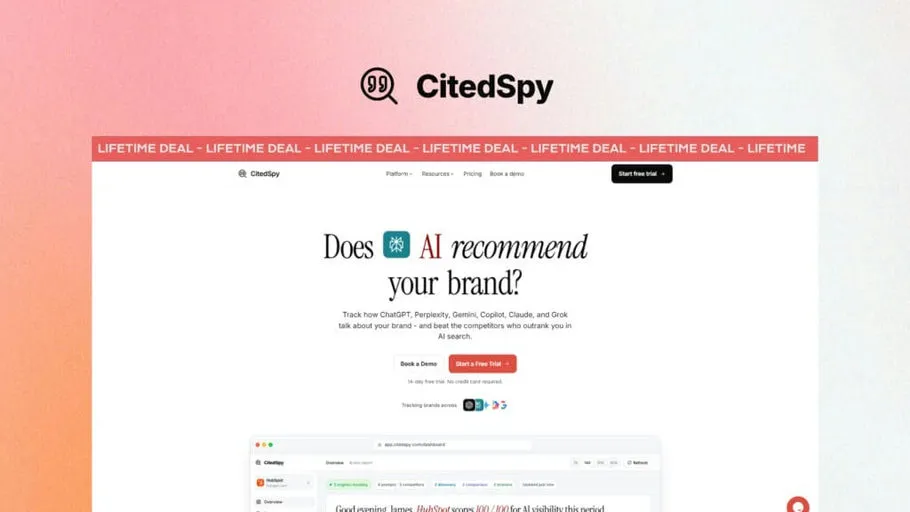
CitedSpy is a focused generative engine optimization (GEO) platform built to answer a single, increasingly important question: does AI recommend your brand — and if not, why? Rather than relying on APIs or occasional manual checks, CitedSpy crawls the live interfaces of major AI engines (ChatGPT, Perplexity, Gemini, Copilot, Claude, Google AI Mode and Grok) multiple times per week, aggregates what these engines say about a brand, and translates that into actionable workstreams. It’s designed for founders, agencies, SEO consultants and marketing teams who need measurable visibility into the “AI answer layer” that now shapes buyer decisions.
Key features and how they work
- Multi-engine tracking: CitedSpy runs the same prompts across multiple AI engines and collects live answers (not API responses), which gives a realistic picture of what end users actually see. Tracking is repeated several times per week to turn volatile sample answers into reliable mention rates and trends.
- Share of Voice & Competitor Benchmarking: You can add competitors (up to 15 per brand in core workflows) and see mention rates, average position, sentiment and direct head-to-head win rates. The share of voice visualization quickly highlights competitive movement you’d otherwise miss.
- Citation source tracking: Every time an AI engine cites a domain, CitedSpy surfaces that source. That builds a searchable database of which domains drive recommendations in your category and flags domains your competitors use that you do not.
- Action Items & Opportunities: The product moves beyond measurement by prioritizing tasks (e.g., add schema, update an FAQ, earn specific citations) with estimated impact and time-to-complete — turning GEO into an executable roadmap.
- Prompt Research & AI Content Studio: It recommends which prompts to track, filters duplicates, and offers a content workflow from brief to draft that is informed by the exact topics and sources the engines actually cite.
- Technical SEO audit: Included checks help close structural gaps that affect AI recommendations, not just traditional keyword positions.
- Agency tooling and integrations: Workspaces, role controls, white-label dashboards, custom domains, Looker Studio connector, API, Zapier, Slack, WordPress, Shopify and MCP server integration allow teams to embed GEO into existing workflows.
- Reporting and exports: Historic rankings, CSV export and white-label PDFs make it usable for client reporting.
Strength in approach: collecting live UI answers instead of API responses is a notable differentiation — API outputs often differ from product-facing answers due to model settings, system prompts and UI-specific behaviors. The frequent sampling strategy (multiple runs per week) also turns noisy AI outputs into usable metrics.
Strengths
- Actionable intelligence: The biggest practical win is that CitedSpy doesn’t leave you with metrics alone. Each gap comes with the lever to pull — which source to earn, which page to fix, or which topic to cover — reducing the “where do we start?” paralysis.
- Competitor-focused visibility: The share-of-voice and source-level breakdowns give agencies a defensible way to show client progress and justify work.
- Integrations and agency features: Workspaces, white-labeling, Looker Studio, API and MCP server connectivity make it straightforward to fold GEO into existing reporting and tooling.
- Product velocity and founder engagement: The team publishes a changelog and roadmap and engages directly in the product Q&A, which indicates active development and responsiveness.
Limitations and areas for improvement
- Language and UI localization: The dashboard and UI are English-only today. While prompts and responses can be tracked for other markets, a truly localized interface and stronger multilingual parsing are on the roadmap and are important for global use.
- Transparency and historical depth: Some users requested more granular visibility — which specific run, model, prompt, and source produced each metric — and deeper historical analysis of how answers evolve over time. Enhancing traceability will strengthen trust in metrics.
- Traffic and GSC integration: Correlating GEO signals with real traffic (e.g., Google Search Console) was flagged as a desired improvement. That integration would help teams connect AI visibility work with concrete traffic and conversion outcomes.
- Early-stage maturity: CitedSpy is focused and intentionally not an all-encompassing SEO tool; teams that need full traditional keyword research might still pair it with other platforms.
Who should use it
- Agencies and consultants who sell outcomes and need defendable, actionable deliverables tied to AI visibility.
- Founders and small marketing teams that want to know whether AI engines recommend their product and want prioritized next steps they can execute.
- Ecommerce and product teams who need to understand which domains and content types drive AI recommendations for their category.
Conclusion
CitedSpy fills a clear and growing gap: the need to monitor and improve brand presence in AI-generated answers. Its strongest value lies in mapping AI recommendations back to specific, actionable fixes and citation targets, and in providing a competitive benchmark that agencies can use with clients. If your go-to-market depends on buyer discovery through LLM-driven answers — or you want a concrete way to measure and improve that layer — CitedSpy is a targeted tool that turns AI mention-rate uncertainty into prioritized work. For teams that require broader traditional SEO functionality or full localization today, it’s best used alongside your existing toolset, but it’s already a practical and rapidly evolving addition to any modern marketing stack.