BuzzHooks
Make viral video and image ads with Cinema Studios, UGC presets, viral hook presets, and video apps
Overview
BuzzHooks is an AI-driven creative platform built to solve the hardest part of short-form video production: the idea and structure stage. Instead of leaving creators, marketers, and small teams staring at a blank timeline, the product provides an ecosystem of hook presets, guided video apps, UGC templates, and director-style tools that take a brief or a single prompt and produce ready-to-post short-form videos and static ad images. The emphasis is on speed, repeatability, and the specific needs of e‑commerce and direct-response advertising.
Core strengths
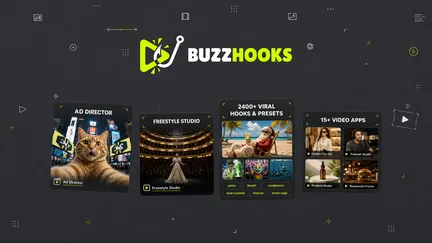
- Hook-first approach: A library of 2,400+ viral hook presets and 37 viral scenes helps you pick attention-grabbing openings and visual scenarios rather than inventing them from scratch.
- Guided video apps: Approximately 15 video apps (Magic Try-On, Product Studio, Podcast Studio, Restaurant Promo, Property Presenter, etc.) provide pre-structured shot flows so you don’t need to storyboard or tinker with timelines.
- UGC and image support: 26 UGC presets geared toward authentic, creator-style clips plus 10 image apps (Product Shot Studio, Food Photography Studio, Thumbnail & Reel Cover Maker, etc.) let teams produce both motion and static creatives in the same workflow.
- Two director modes: Ad Director converts a rough brief and reference images into structured scenes and a ready-to-generate video; Cinema Studio lets you start from an open prompt and craft custom scenes, characters, and assets when you need more control.
- Reference-image friendliness: Both Ad Director and Cinema Studio accept product and character images, which helps keep generated outputs aligned with brand assets and real-world products.
- Built-in creative assistant: The Marketing Copilot is an integrated AI chat designed to help shape the right video for your use case, speeding iteration and reducing creative uncertainty.
Workflow and UX
The platform is built around quick iteration. You can either:
- Browse hook presets and video apps to assemble a project from composed blocks, or
- Start with a prompt in Cinema Studio to freeform design scenes and characters.
Video apps are form-driven: you fill simple fields to define each shot, preview an example, then generate. That reduces the learning curve—no timeline juggling or complex editing required for most ad formats. Image apps run alongside video apps so you can produce still creatives that match the visual language of your video outputs.
Output quality, models, and credits
BuzzHooks currently uses Seedance 2.0 as its main video model, chosen for fidelity when working with user reference images. The platform uses a credit-based system: credits are interchangeable across video and image apps, with example consumption levels provided (a 5-second 480p video costs ~100 credits; 720p costs roughly double). The team signals intent to adopt new models as they become more cost-effective, which could reduce credit costs and improve output quality over time.
There’s also a BYOK (Bring Your Own Key) option that increases monthly credit limits by 5x, 10x, or 15x depending on plan, which is useful for heavy-volume creators and agencies.
Strengths in practice
- Speed to publish: For teams that need many ad variations, the hook-led templates and guided apps let you push out multiple concepts without a production crew.
- Consistent brand references: Ability to feed real product images results in outputs that better match physical products and branding than purely synthetic generations.
- Format coverage: The combination of video and image apps means you can generate ad suites (video + thumbnails + static ads) within one workflow.
- Good for non-editors: Marketers and founders without timeline editing skills can still produce polished short-form assets.
Limitations and trade-offs
- Model dependency: Quality and credit cost are tied to the backend model (Seedance 2.0). While quality is solid for many use cases, very high-end motion work may still require traditional production.
- Template boundaries: Guided apps are fast but can constrain creative flexibility; Cinema Studio and Ad Director provide more freedom but may require more experimentation to get precise results.
- Credit economics: The credit model requires planning for scaling; heavy-volume users should evaluate BYOK or higher credit allowances.
- Newer company risks: As a young product, feature maturity, stability, and documentation may evolve rapidly; expect an active roadmap and iterative changes.
Who should use it
- E-commerce brands that need frequent ad variations and product-focused videos.
- Small agencies and performance marketers who must A/B test hooks and creatives quickly.
- Creators and founders who want creator-style UGC ads without hiring editors or talent.
- Teams that value rapid ideation paired with brand-consistent outputs.
Final verdict
BuzzHooks succeeds at its core promise: removing the creative-block friction in short-form ad creation. Its hook-first library, purpose-built video apps, and reference-image-aware studios make it a strong option for volume-driven ad production and small teams that lack full production resources. It’s especially valuable where speed, repeatability, and consistent brand references are priorities. For projects that require cinematic motion-quality or bespoke post-production, BuzzHooks is best used as an ideation and draft-generation engine that feeds into more advanced production when needed. Overall, it’s a compelling, feature-rich platform for anyone building frequent short-form social ads and creator-style content.